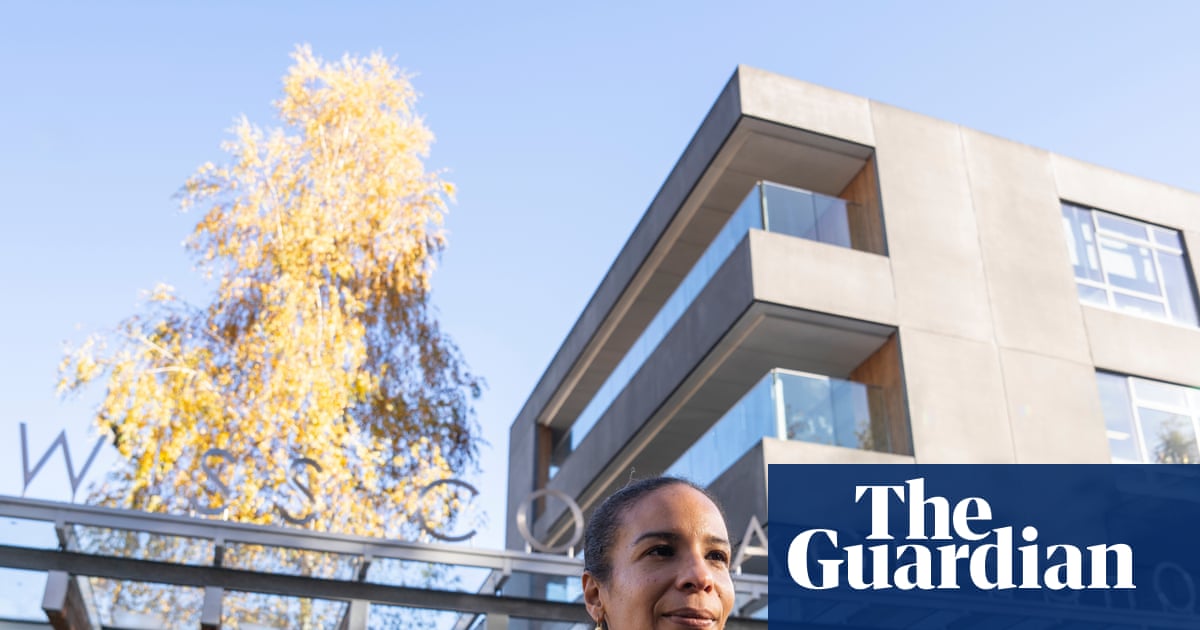
‘We don’t produce Neets’: the London school recognised at World’s Best School awards
0 / 37
English
中文
For Maria, the hardest part of having a child with complex needs has been the grief: mourning the life she had imagined for her son, for her family – and coming to terms with how lonely the reality of parenting him can be.
(暂无翻译)
“There are wonderful days but there are very hard ones too,” she added, tears coursing down her face.
(暂无翻译)
Thanks to a school dedicated to children and young people with multiple, severe and complex special needs, however, Maria is not alone any more.
(暂无翻译)
Already the recipient of seven consecutive “outstanding” Ofsted ratings, the Swiss Cottage School, Development and Research Centre, operated by the local authority in Camden, has now received worldwide recognition as winner of the World’s Best School prize for community collaboration. It is the first time a school in England has won the prize.
(暂无翻译) (暂无翻译)
The school has attracted the attention of those in government: the education secretary, Lucy Powell, said it was “a case in point of what we want to replicate through our Send reforms: a system where every child feels they belong and can access the support they need, close to home, without a fight”.
(暂无翻译)
On paper, the Swiss Cottage school is just one of more than 1,000 state-funded special schools in England, catering for the country’s 10,000-plus children with profound developmental and learning difficulties.
(暂无翻译)
But in reality, “Swiss”, as its families fondly call it, is run very differently. “Swiss has become our second family,” said Maria. “Support for children with complex needs is split across education, healthcare and social services. But Swiss does it all for us.” “You have no idea,” she added, breathing out a great sigh of relief, “how much stress and weight that removes from parents’ shoulders.” Instead of focusing solely on teaching their own pupils, Swiss is also different in that it operates an integrated research and training hub, leads teacher training programmes and conducts educational research.
(暂无翻译) (暂无翻译) (暂无翻译) (暂无翻译)
It shares its best practices with hundreds of mainstream and special schools across the UK and internationally: over the last year alone, it has had delegations from South America, Uzbekistan, Saudi Arabia and Sweden.
(暂无翻译)
Syra Sowe, head of the school, is reluctant to name names, but several UK schools have changed their teacher training, curriculums and planning, she said, after Swiss’s input.
(暂无翻译)
“Just to be clear, we don’t just use these partnerships to disseminate best practice,” she added.
(暂无翻译)
“We also learn from others.” Until Maria found Swiss, her family were stuck in a nightmare. Her 18-year-old son, Alex, has Sotos syndrome, a rare genetic condition that has left him struggling with epilepsy, scoliosis, autism and severe developmental delays. “Before Alex came here, no one understood him and he was raging.
(暂无翻译) (暂无翻译) (暂无翻译)
He hit, kicked and bit everyone; he was beyond therapy,” she said. No nursery would keep Alex for more than an hour before calling his mother to collect him.
(暂无翻译) (暂无翻译)
By contrast, he has never had to leave Swiss early. “This school has given him back his childhood.
(暂无翻译) (暂无翻译)
They immediately saw behind his disabilities to a child who needed an education – and had the right to an education,” Maria said. “He’s now a sociable young man who’s curious about everything, and who loves learning.” Alex will leave Swiss this September and Maria is determined that his education will continue.
(暂无翻译) (暂无翻译)
Her son, she is resolved, will not become one of the approximately 38% of Neets (not in education, employment or training) who have multiple or complex needs – roughly translating to about 380,000 young people. With the help of Swiss, Maria is confident this will not happen to Alex. It is a matter of intense pride to Sowe that her students all, without exception, go on to further education, training or specialist support.
(暂无翻译) (暂无翻译) (暂无翻译)
“We don’t produce Neets,” she said. “Any limits we think these children have are actually limits on our own imaginations and ambitions for them.” The potential can be unclear to the untrained eye but teachers at the school see it clearly.
(暂无翻译) (暂无翻译)
On a tour of the school, one pupil grabbed the camera of the Guardian photographer and smelled it. Then he took Sowe’s lanyard and sniffed it too. Grinning, he leapt back to the plateglass window of the school’s roof garden, happily slapping it, rocking and making a series of vocalisations. Sowe’s reaction was one of pride.
(暂无翻译) (暂无翻译) (暂无翻译) (暂无翻译)
“That child has the most incredible olfactory sensitivity and olfactory memory,” she said. “He virtually navigates the world through smell; he’s amazing.” Key to drawing out each child’s individual potential is the bespoke curriculum the school provides for each child, adjusted every week around the child’s evolving individual communication, cognitive and physical needs, at meetings between teaching staff, therapists, specialists, nurses, physiotherapists and the NHS Camhs professionals embedded in the school. The school pushes the conventional boundaries of a special school in other interesting ways: rather than preparing pupils for a world they may struggle to access, its Employ ME programme not only gives its young people experience of working in the outside world – but aims to give the outside world experience of their unique skills and strengths.
(暂无翻译) (暂无翻译) (暂无翻译)
“A key part of what we do is teach the universe how incredible our young people are,” said Sowe.
(暂无翻译)
“And what they have to offer, so the universe has more to offer to them when they leave us.”
(暂无翻译)
仅供学习使用,如有侵权请联系删除 · 查看原文