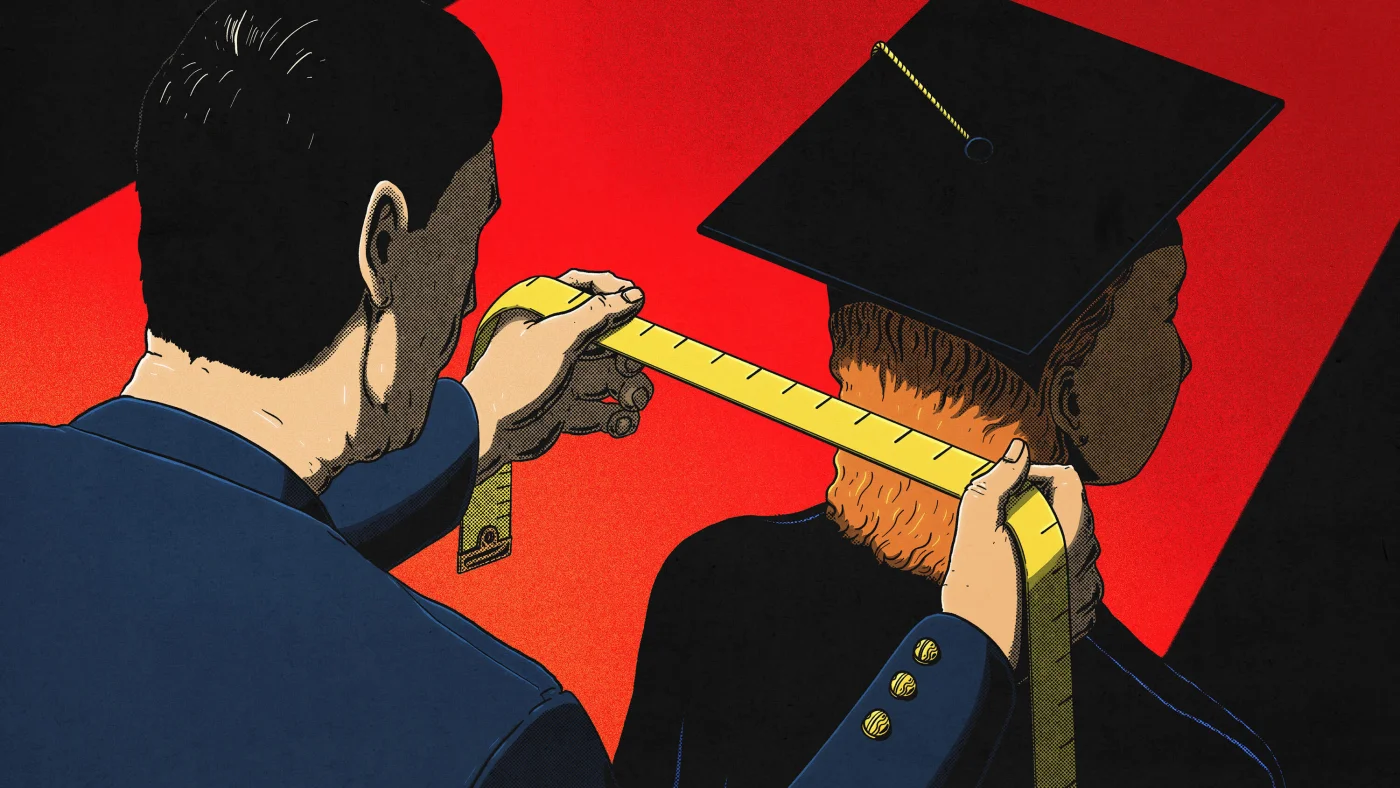
Trump proposed a 'secret weapon' to police colleges. It will soon become reality
0 / 63
English
中文
Catch up on what you missed with our Education newsletter, sent weekly.
(暂无翻译)
The Trump administration has made many changes to education policy that are hard to miss: cutting the U.S. Education Department's workforce by roughly half, canceling research funding, uprooting special education staff, upending student civil rights protections, overhauling student loan repayment plans, scaling back graduate school loans — the list goes on.
(暂无翻译) (暂无翻译)
But the latest change — one President Donald Trump has called his "secret weapon" — has gone largely unnoticed, even as it's set to take effect in July. That's because it's hidden inside one singularly boring word: "The time has come to reclaim our once great educational institutions from the radical left," Trump said in a 2023 campaign video.
(暂无翻译) (暂无翻译)
"Our secret weapon will be the college accreditation system." Specifically, he pledged to overhaul it — a notably wonky threat from a politician who usually disdains wonkery.
(暂无翻译) (暂无翻译)
Now, the Education Department has kept Trump's promise. It's the system the U.S. government relies on to determine which colleges and universities are worthy of receiving millions, even billions of dollars in federal student loans and grants.
(暂无翻译) (暂无翻译)
In practical terms, colleges pay membership dues to third-party, nonprofit accreditors that then review the schools across a range of categories, including curriculum quality, faculty qualifications, physical facilities, the soundness of their finances and so on.
(暂无翻译)
An accreditor's job, essentially, is to make sure college students are getting good value and to prevent shady schools from pocketing taxpayer dollars without delivering quality degrees.
(暂无翻译)
Decades ago, Congress also made clear that accreditors are not part of the government.
(暂无翻译)
"Congress wanted accrediting agencies to be independent of the federal government.
(暂无翻译)
It wanted agencies to set standards independent of the federal government," says Antoinette Flores at the Council for Higher Education Accreditation. Federal law does require that accreditors assess schools in several key areas — such as student achievement, faculty and curriculum — and it gives the Department oversight.
(暂无翻译) (暂无翻译)
But Flores says, the law lets accreditors decide what standards a school must meet to determine its worthiness. In keeping with Trump's 2023 promise, the department has now overhauled the federal rules for accreditors — changes it says will foster innovation and lower costs.
(暂无翻译) (暂无翻译)
Some higher education experts worry these changes will not only hurt students but also allow the department to further punish schools it doesn't like and even police campus political speech. "This rule gives [the Education Department] the authority to meddle in the internal affairs of colleges and universities in ways that they never have been able to in the past," warns Bob Shireman, an accreditation expert and former top official in the Obama Education Department.
(暂无翻译) (暂无翻译)
While the Education Department cannot legally tell accreditors precisely how to evaluate colleges and universities, it does oversee some key requirements, and these new rules dramatically expand those requirements and the department's authority with them.
(暂无翻译)
Most notably, accreditors must now evaluate school policies on intellectual diversity, "ensuring that students are exposed to a range of viewpoints," according to a department press release.
(暂无翻译)
It's not entirely clear how that requirement will work in practice, but opposition has been loud.
(暂无翻译)
"For the first time," Shireman says, "you will have an avenue for the federal government to go in at least to an accreditor, but through accreditors to colleges, and tell them what balance of points of view the federal government thinks they should have."
(暂无翻译)
The department could then, conceivably, threaten a school's accreditation and, ultimately, its access to federal student aid if it considers them out of balance.
(暂无翻译)
Of this change, PEN America, a nonprofit dedicated to defending free expression, warned that "this is part of a plan to weaken [higher education] and its historic protections for the freedom to think, teach, research and learn."
(暂无翻译)
The Education Department argues it's doing the opposite, calling this "a commonsense step toward restoring intellectual diversity by … creating an environment where differing perspectives can be debated openly and fairly," wrote Ellen Keast, communications director for the under secretary, in a statement to NPR.
(暂无翻译)
"The regulations do not mandate any specific policies," Keast added, "nor do they give the Department any authority to police speech.
(暂无翻译)
Instead, they reinforce a fundamental principle: truth emerges through rigorous debate, not enforced consensus." Nevertheless, even some conservatives have expressed anxiety over this expansion of federal power.
(暂无翻译) (暂无翻译)
Beth Akers, an economist and senior fellow at the conservative American Enterprise Institute, supports much of the overhaul but says this particular change goes too far. "[It] does put the administration sort of in a seat of judgment over the institutions, over the accreditors, about whether or not they are appropriately teaching ideology.
(暂无翻译) (暂无翻译)
And that is something I'm uncomfortable with," Akers says. While the Education Department insists it cannot police political speech on campus, that is what Trump promised in that 2023 video, when he pledged to "fire the radical-left accreditors that have allowed our colleges to become dominated by Marxists, maniacs and lunatics."
(暂无翻译) (暂无翻译)
Not all of the changes are controversial.
(暂无翻译)
One enjoys some bipartisan support, says Emily Rounds, senior higher education policy adviser at the center-left think tank, Third Way. That change will push accreditors to give more weight to student outcomes, Rounds says, focusing on questions like, "How much are they going to be earning?
(暂无翻译) (暂无翻译)
What are the licensure pass rates for certain programs? What is the graduation rate? Does an institution retain students year to year or are students dropping out?" The new accreditation rule changes are set to go into effect ahead of the 2027-28 academic year.
(暂无翻译) (暂无翻译) (暂无翻译) (暂无翻译)
Because they were made through the traditional rulemaking process, it will be difficult for Democrats to undo them. Fresh political tension over accreditation began to boil during the Biden administration — between Republican-led states and accreditors they considered too powerful and too liberal.
(暂无翻译) (暂无翻译)
"The way in which [accreditors] are exerting their authority has really rubbed people the wrong way when it came to these ideological standards they're putting onto institutions," Akers says.
(暂无翻译)
Florida and North Carolina actively clashed with their accreditors over issues including diversity, equity and inclusion and viewpoint diversity on their public university campuses.
(暂无翻译)
"When we said, 'No DEI,' the accreditor was telling our universities, 'Oh no no, you're not gonna get accredited unless you do DEI,'" said Florida's Republican governor, Ron DeSantis, in June 2025.
(暂无翻译)
"Who the heck are they to say what our universities have to do?" DeSantis pushed for the creation of a new accreditor to replace the longstanding accreditor of Florida's public universities, saying he hopes to "upend the monopoly of the woke accreditation cartels."
(暂无翻译) (暂无翻译)
Five other state university systems — in Georgia, North Carolina, South Carolina, Tennessee and Texas — have also said they will switch to this new accreditor, the Commission for Public Higher Education.
(暂无翻译)
Another of the Trump administration's stated goals with its accreditation overhaul is cutting red tape and making it easier for schools and even states to create new accreditors.
(暂无翻译)
That, the administration hopes, will lead to more accreditors for schools to choose from. "The rule promotes greater competition and innovation," the department said in its press release.
(暂无翻译) (暂无翻译)
Competition, according to the administration, will allow schools to shop around for an accreditor that best fits their needs and lowers costs for schools and students alike.
(暂无翻译)
What's more, if a school doesn't like its accreditor, it will be easier to switch mid-stream. One thing is certain: This will weaken traditional accreditors and strengthen schools.
(暂无翻译) (暂无翻译)
AEI's Beth Akers argues that's not a bad thing and that this shift will empower schools to innovate and take chances.
(暂无翻译)
"We've been teaching students the same way for a very long time. Come sit in a lecture, take a test and then after you've sat there long enough, we give you the credits." Under the new rules, Akers hopes, schools will be freer to experiment with everything from the value of a credit hour to how much time a student actually needs to spend inside a classroom.
(暂无翻译) (暂无翻译) (暂无翻译)
But Bob Shireman, the former Obama administration official, warns that forcing accreditors to compete for the schools they'll be auditing won't increase quality.
(暂无翻译)
"One person's red tape is another person's consumer protection: Checking to see if the fire extinguishers have expired is red tape." Similarly, Shireman worries that making it easier for colleges and universities to jump from one accreditor to another could also weaken student protections.
(暂无翻译) (暂无翻译)
"If one [accreditor] starts identifying problems, [schools] simply shift their weight over to another accreditor.
(暂无翻译)
And so it becomes whack-a-mole in terms of oversight of colleges, and we fail to catch problems soon enough."
(暂无翻译)
仅供学习使用,如有侵权请联系删除 · 查看原文