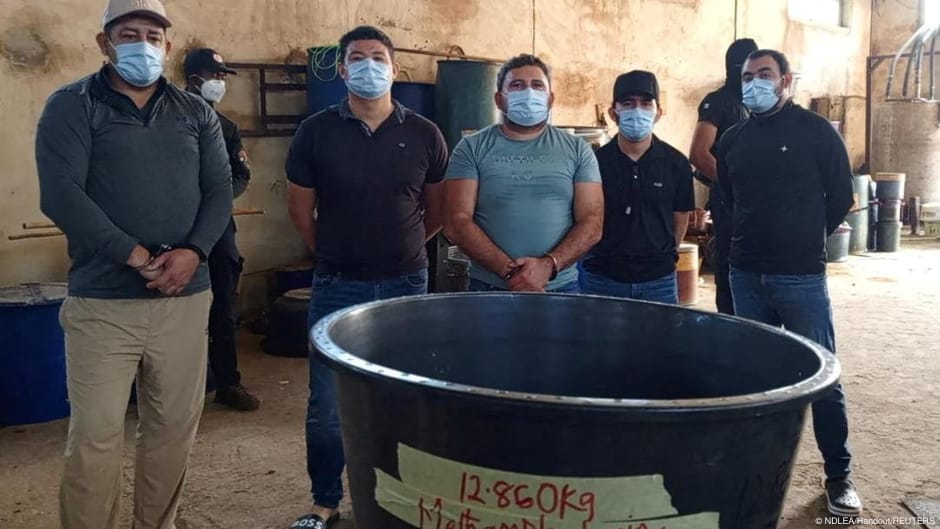
Nigeria detains 5 Mexicans, confiscates over $220 million of meth
0 / 16
English
中文
Nigeria's anti-drug agency said Mexican experts were allegedly recruited by a Nigerian national to run a meth laboratory in the southeastern state of Enugu.
(暂无翻译)
Nigeria's National Drug Law Enforcement Agency (NDLA) said Wednesday it had arrested five Mexicans and confiscated over $220 million (around €200 million) in methamphetamine as part of a significant drug bust.
(暂无翻译)
The agency said the Mexican experts were allegedly recruited by a Nigerian national to run a meth laboratory in the southeastern Nigerian state of Enugu.
(暂无翻译)
"A total of 1,512 kilograms of methamphetamine, finished and in production, with an estimated value of $226.8 million was recovered from the clandestine factory," NDLA spokesperson Femi Babafemi said.
(暂无翻译)
Nigeria first rejected the entry of the Mexicans into the country in August. They later entered Nigeria again in September via neighboring Benin using forged passports, with authorities then putting them under surveillance.
(暂无翻译) (暂无翻译)
On November 11, the Mexicans were taken into custody at the Enugu lab after their movements were tracked by the Nigerian government. A Nigerian was also arrested in a nearby hotel.
(暂无翻译) (暂无翻译)
The latest drug bust comes after Nigerian authorities in May also detained 10 people in a anti-meth operation in the southwest, including three Mexicans.
(暂无翻译)
The arrests raise concern that Mexican cartels are getting a foothold in Africa for international drug trafficking. In addition to Nigeria, South Africa is another country where Mexicans have been arrested for being involved in a meth lab.
(暂无翻译) (暂无翻译)
According to Vanda Felbab-Brown, an expert at the Washington DC-based Brookings Institution, Mexican cartels such as the Sinaloa Cartel and the Cartel de Jalisco Nueva Generation (CJNG) have expanded their operations into other continents such as Africa.
(暂无翻译)
To view this video please enable JavaScript, and consider upgrading to a web browser that supports HTML5 video In a June testimony to the US Senate Caucus on International Narcotics Control, Felbab-Brown said the cartels find "desirable partners" for production in countries such as South Africa and Kenya due to factors such as "limited law enforcement capacities and entrenched criminal and corrupt networks."
(暂无翻译)
According to the UN Office on Drugs and Crime,criminal networks often take advantage of porous borders in the West and Central Africa region to carry out activities such as illicit drug trafficking.
(暂无翻译)
"Many countries in the region have vast territory and borders are located either in very remote or densely populated areas, thus making law enforcement activities particularly difficult to conduct in an efficient manner," the office said.
(暂无翻译)
"The porous nature of the borders in West and Central Africa is a major factor of insecurity: the borders are neither demarcated or sufficiently controlled."
(暂无翻译)
仅供学习使用,如有侵权请联系删除 · 查看原文