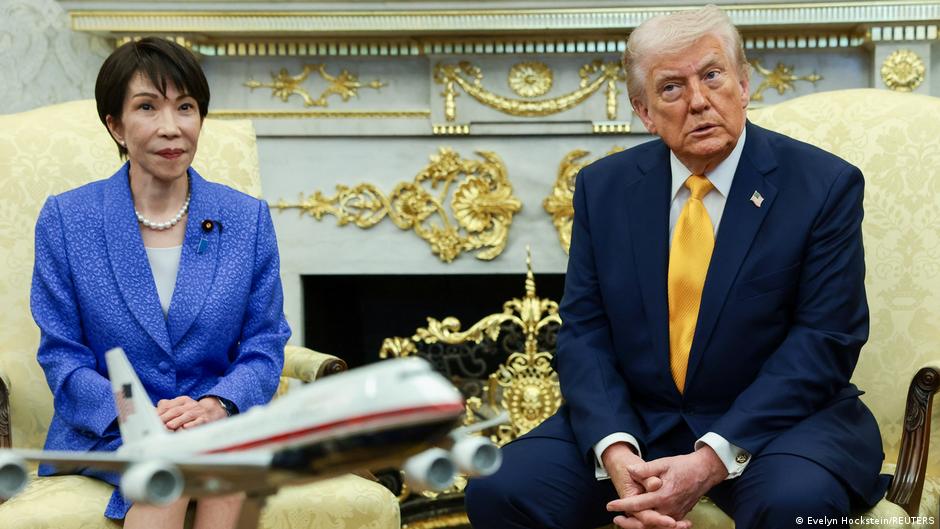
Japan watches for signs of change in Trump's foreign policy priorities
0 / 30
English
中文
Tokyo fears the drubbing US President Donald Trump suffered in last week's midterm election may push him to pursue a diplomatic quick win at the expense of Washington's allies in the Indo-Pacific.
(暂无翻译)
With just a week to go before the leaders of the United States, China and Russia are expected to meet on the sidelines of the Asia-Pacific Economic Cooperation (APEC) summit, Japan is closely watching for signs of any shift in Washington's policy toward the Indo-Pacific.
(暂无翻译)
The APEC gathering, taking place this year in the Chinese city of Shenzhen, is scheduled for November 18-19.
(暂无翻译)
Tokyo fears that the drubbing US President Donald Trump suffered in last week's midterm elections may push him to seek a diplomatic quick win, one he can point to as evidence of his statesmanship but that fails to take into account the interests of Washington's allies in the region.
(暂无翻译)
Tokyo has moved swiftly to try to ascertain the mood in a White House that was left reeling by the results of the November 3 midterm election.
(暂无翻译)
Japanese Foreign Minister Toshimitsu Motegi held talks with US Secretary of State Marco Rubio on the sidelines of the G7 foreign ministers' meeting in Paris on Monday.
(暂无翻译)
Following their meeting, the Japanese Foreign Ministry released a statement saying that both sides agreed to "further advance security cooperation to strengthen the deterrence and response capabilities of the Japan-US alliance."
(暂无翻译)
They also vowed to "maintain close communication" on the situation in the Indo-Pacific, without providing further details.
(暂无翻译)
To view this video please enable JavaScript, and consider upgrading to a web browser that supports HTML5 video "Japan's concern is that with Trump becoming a lame duck in domestic politics, he will use his presidential authorities to shift his focus to foreign policy," said Sebastian Maslow, a professor of politics at the University of Tokyo.
(暂无翻译)
"A US deal with China may provide President Xi [Jinping] the ability to intensify pressure on Japan," he told DW.
(暂无翻译)
"With Sino-Japanese relations severely strained, this will put Prime Minister [Sanae] Takaichi in a difficult position and she will have to reassess how to navigate US-China relations." Margarita Estévez-Abe, associate professor at Syracuse University's Maxwell School of Citizenship and Public Affairs and an expert on Japanese politics, said Japan fears "a transactional Trump who treats Taiwan as a bargaining chip."
(暂无翻译) (暂无翻译)
She pointed out that after the May summit with Xi, Trump described US arms sales to Taiwan as "a good negotiating chip with China."
(暂无翻译)
Tokyo is also "frustrated" that Trump has not come to its support over the rare earth export restrictions China imposed on Japan after Takaichi's comments on Taiwan last year, with the Trump administration treating the China-Japan feud as "Tokyo's problem," she said.
(暂无翻译)
Furthermore, Japan has concerns about Washington's foreign policy positions toward North Korea and Russia.
(暂无翻译)
"Trump has not damaged the US-Japan alliance the way he has strained NATO, but his outreach to Moscow and Pyongyang worries Tokyo," said Estévez-Abe.
(暂无翻译)
"The US relies on Japan as its main military base in the Indo-Pacific, so it is not in Washington's interest to embolden Russia and North Korea against Japan," she added.
(暂无翻译)
"But if American softness does raise the threat to Japan, Japanese trust in the alliance will erode. Japan can only hope that doesn't happen." To view this video please enable JavaScript, and consider upgrading to a web browser that supports HTML5 video Ultimately, Tokyo wants to preserve the geopolitical balance in the region and prevent already strained tensions from escalating further.
(暂无翻译) (暂无翻译) (暂无翻译)
But Japan is increasingly questioning the commitment of a security and trade partner that has stood by it since 1945.
(暂无翻译)
"Japan's security strategy emphasizes preserving the status quo in terms of defending the liberal international order and containing China's role in the Indo-Pacific," said Maslow. "However, in order to achieve this, Japan has emphasized the role of the US alliance as a cornerstone of its foreign policy and security.
(暂无翻译) (暂无翻译)
The reality still is that Japan has no 'plan B' if the alliance unravels." Efforts to strengthen Japan's military are embedded within the framework of the US-Japan alliance, he pointed out. And while there have been calls for Japan to develop an autonomous defense capability, achieving that in the short term is unrealistic given the limitations of its defense industry and a lack of key resources, including critical intelligence.
(暂无翻译) (暂无翻译) (暂无翻译)
Over the past decade, Tokyo has proactively diversified its security partnerships, stepping up defense cooperation with European Union member states and NATO, forging a quasi-alliance with Australia, and joining a range of minilateral frameworks across the Indo-Pacific, including with the Philippines. This reflects Japan's desire to play a more proactive role in shaping regional and global security, Maslow said.
(暂无翻译) (暂无翻译)
To view this video please enable JavaScript, and consider upgrading to a web browser that supports HTML5 video Tokyo hopes no major clashes erupt in the region for the remaining two years of Trump's term and that Washington's resolve is not tested before a new and "strategically more amenable administration comes in," Estévez-Abe said.
(暂无翻译)
Maslow stressed, however, that "hope is not a strategy" and that Tokyo needs to maintain efforts to protect the alliance and double down by demonstrating its own commitments to security with even greater defense spending and by safeguarding economic security.
(暂无翻译)
仅供学习使用,如有侵权请联系删除 · 查看原文