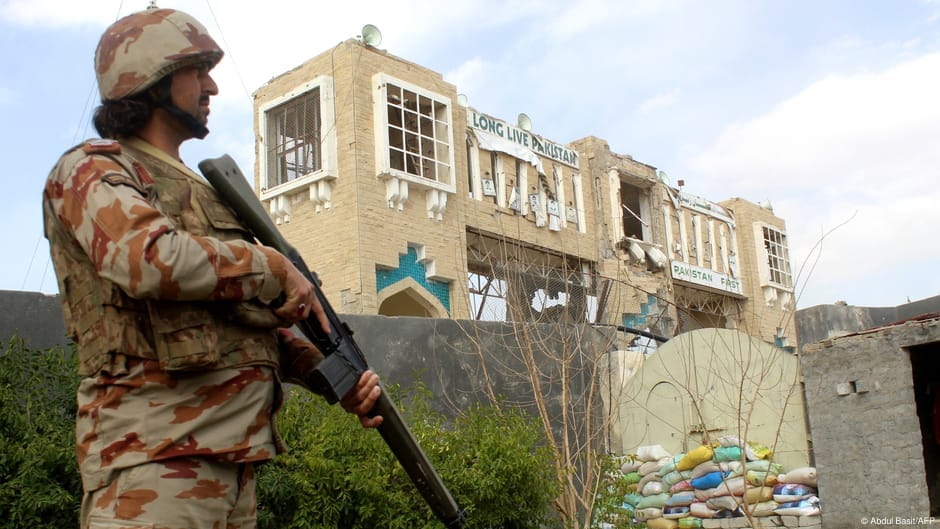
Is Pakistan backing anti-Taliban groups in Afghanistan?
0 / 43
English
中文
The Taliban rulers in Afghanistan have accused Pakistan of aiding and sheltering armed resistance groups. The allegations come amid heightened tensions and are likely to deepen the rift between the two neighbors.
(暂无翻译) (暂无翻译)
The Taliban authorities in Afghanistan claim that the Pakistani government is supporting armed Afghan groups that are opposed to their rule, an accusation Islamabaddenies.
(暂无翻译)
Taliban Foreign Minister Amir Khan Muttaqi recently alleged that Pakistan had launched a "project to destabilize Afghanistan."
(暂无翻译)
He claimed that "thousands of armed individuals have gathered along the Durand Line [Afghanistan-Pakistan border] to undermine the stability achieved in Afghanistan."
(暂无翻译)
The accusations come after months of border clashes between Afghan Taliban and Pakistani forces.
(暂无翻译)
In July, the Afghanistan Freedom Front (AFF), an anti-Taliban group, reportedly clashed with Taliban forces in the Zebak district of Badakhshan, a northeastern Afghan province. The group said it also carried out attacks in Nooristan and Kunar provinces in October.
(暂无翻译) (暂无翻译)
Another "resistance group," the United Front of Afghanistan, claimed it attacked Taliban forces in Kandahar province along the border with Pakistan.
(暂无翻译)
"The people who created insecurity in Badakhshan crossed from Chitral [in Pakistan] and later fled back to Chitral. They had been brought in. Even Pakistani military personnel were with them," alleged Zabihullah Mujahid, the Taliban's main spokesperson, in an interview with DW's Pashto-Dari service in September.
(暂无翻译) (暂无翻译) (暂无翻译)
Pakistan's Ministry of Information swiftly dismissed the allegations as propaganda.
(暂无翻译)
Groups that oppose Taliban rule in Afghanistan say they are not supported by any external force, and their resistance is purely indigenous.
(暂无翻译)
To view this video please enable JavaScript, and consider upgrading to a web browser that supports HTML5 video More than five years since returning to power in Kabul, the Taliban have consolidated their control over Afghanistan and largely suppressed both armed resistance groups and political dissidents.
(暂无翻译)
Shinkai Karokhail, a former Afghan lawmaker, told DW it would be logistically difficult for anti-Taliban Afghan groups to cross the Pakistani border and enter Afghanistan without Islamabad's support, referring to clashes in Badakhshan and Nooristan provinces.
(暂无翻译)
"It is simply impossible," she said. The Taliban themselves maintained close ties with Pakistan in the 1990s during their first stint in power.
(暂无翻译) (暂无翻译)
Some US officials have even claimed that Islamabad didn't relinquish its support to the Islamist group even after the 2001 September 11 terrorist attacks in the United States. Islamabad has always refuted these allegations. Afrasiab Khattak, a Pakistani political analyst and former senator, believes that Pakistani support for anti-Taliban groups is "real."
(暂无翻译) (暂无翻译) (暂无翻译)
"Taliban opponents come to Islamabad, hold meetings, and it is a part of Pakistan's policy toward Afghanistan," he told DW.
(暂无翻译)
Qandil Abbas, an associate professor of politics and international relations at Quaid-i-Azam University in Islamabad, disagrees.
(暂无翻译)
"Pakistan may provide political support [to Taliban opponents], but not military support," she told DW.
(暂无翻译)
Ali Ahmad Jalali, a professor at the Near East South Asia Center for Strategic Studies at the National Defense University in Washington DC, said it is possible that Islamabad is backing opponents of the Taliban as "leverage."
(暂无翻译)
"When such incidents take place along the Afghanistan-Pakistan border, and given Pakistan's history of support for Afghan groups, it would not be surprising if Pakistan is supporting these groups," Jalali said.
(暂无翻译)
To view this video please enable JavaScript, and consider upgrading to a web browser that supports HTML5 video Pakistani officials have repeatedly demanded that the Taliban take action against anti-Pakistan militant groups, particularly the Tehreek-e-Taliban Pakistan (TTP), a militant group responsible for attacking Pakistani civilians and soldiers, and the Baloch Liberation Army (BLA), an outlawed armed separatist group active in its western Balochistan province.
(暂无翻译)
Islamabad alleges that these groups organize and launch attacks on Pakistan from Afghan territory with Taliban support.
(暂无翻译)
"Meaningful progress requires Afghan authorities to address legitimate security concerns of neighboring countries, particularly the threat of terrorism," Pakistani Foreign Minister Ishaq Dar said this week at the Economic Cooperation Organization (ECO) summit in Islamabad.
(暂无翻译)
The Pakistani government said on Friday that Afghanistan was not invited to participate in the ECO gathering as Pakistan does not recognize the Taliban regime in Kabul.
(暂无翻译)
Jalali, who served as Afghanistan's interior minister from 2003 to 2005, argued that Islamabad is demanding something the Taliban may neither be willing nor able to provide.
(暂无翻译)
"Pakistan wants the Taliban to cooperate in fighting against groups such as the TTP.
(暂无翻译)
But the TTP has long fought alongside the Afghan Taliban.
(暂无翻译)
There are ideological as well as friendly ties between the two. They seek a similar political system, and some Afghan Taliban members may even be among TTP fighters," the analyst added. Experts also point to the Taliban's efforts to strengthen relations with India, Pakistan's long-standing regional rival, as a cause of concern for Islamabad. Malek Sitez, an Afghan international relations researcher, argued that Pakistan was not keen on Kabul getting closer to New Delhi but added that Pakistan no longer had the kind of influence over Afghanistan that it had in the past.
(暂无翻译) (暂无翻译) (暂无翻译) (暂无翻译)
To view this video please enable JavaScript, and consider upgrading to a web browser that supports HTML5 video Despite accusations and counteraccusations from both sides, Jalali did not believe that Pakistan was seeking regime change in Afghanistan.
(暂无翻译)
"I do not think Pakistan can or wants to overthrow the Taliban and replace them with another group," he underlined.
(暂无翻译)
Instead, he stressed, Islamabad's objective is to pressure the Taliban into cooperating against the TTP.
(暂无翻译)
Aziz Barez, a political analyst, was of the view that Afghan groups opposed to the Taliban could not fully trust Islamabad, adding that they may welcome alleged Pakistani support but are also aware that such backing could be temporary.
(暂无翻译)
"It is possible that Pakistan and the Taliban will resolve their differences tomorrow and become close allies again," he told DW. Ahmad Waheed Ahmady and Helay Asad contributed to this report.
(暂无翻译) (暂无翻译)
仅供学习使用,如有侵权请联系删除 · 查看原文