Gen Z protests: Do Baby Boomers really have it better than young people?
0 / 51
English
中文
Should young people in Germany be more worried about their future than Baby Boomers were in the 1980s and 1990s? Or should both generations take to the streets and protest together? DW checked the data.
(暂无翻译) (暂无翻译) (暂无翻译)
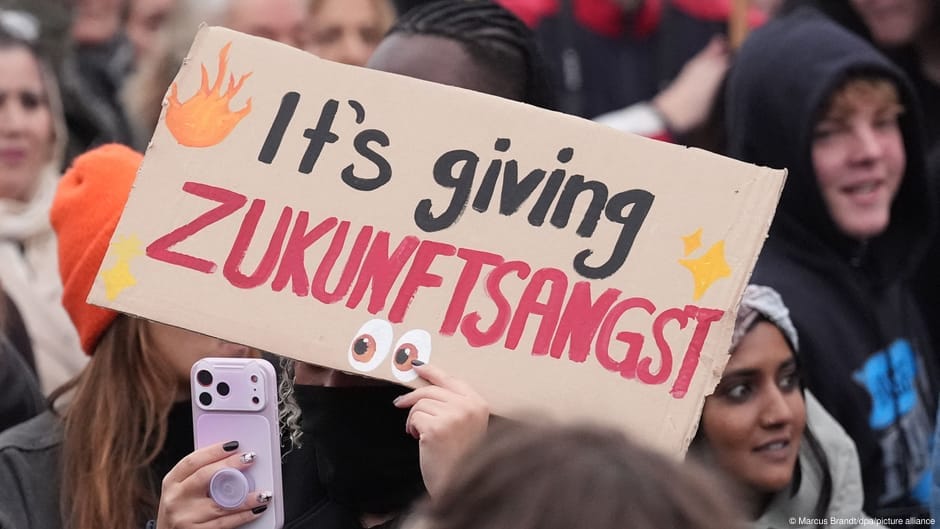
Young people across Germany and Europe are taking to the streets, voicing fears of a bleak future.
(暂无翻译)
But is that really the case? Does Gen Z face greater challenges than Baby Boomers did in the 1990s? What do the two generations have in common, and where do their experiences differ?
(暂无翻译) (暂无翻译) (暂无翻译)
"Of course, it's fair to ask, 'Were things just as tough for you back then?'" youth researcher Simon Schnetzer tells DW. "But young people see that things are difficult for them now, and say that's why they need support today."
(暂无翻译) (暂无翻译)
Schnetzer, who wrote the annual Youth in Germany study, highlights one key question raised by the recent demonstrations across Europe as: "Have we given young people the conditions they need to live and work here with confidence, and to keep this system funded?"
(暂无翻译)
His straightforward answer is no. A survey of the statistics shows that both Gen Z and the Baby Boomers are affected by major societal changes, but in different ways. DW surveyed data on pensions, education, housing and climate change to find out more.
(暂无翻译) (暂无翻译) (暂无翻译)
The facts point to a clear trend: Fewer and fewer young people are having to support an ever-growing number of retirees. According to the Germany's public pension insurance system, there were 3.73 contributors for every retiree in 1957. By 2025, that figure had fallen to just 2.1.
(暂无翻译) (暂无翻译) (暂无翻译)
By 2045, this number is projected to drop to just 1.73 contributors per retiree. In absolute terms, this means 35.35 million contributors will be financing pensions for 16.82 million retirees.
(暂无翻译) (暂无翻译)
To cushion this trend and keep contribution rates stable, the pension system already receives around €118 billion [$131 billion] in annual government subsidies. This amounts to roughly 25% of the federal budget. That means an increasing share of the population will be called upon to help fund pensions.
(暂无翻译) (暂无翻译) (暂无翻译)
There are also signs that many people's pensions are already falling short of covering their living expenses. The number of retirees relying on federal basic income support has risen from 257,000 in 2003 to 738,000 in 2024.
(暂无翻译) (暂无翻译)
To view this video please enable JavaScript, and consider upgrading to a web browser that supports HTML5 video Rising rents hit low-income households particularly hard.
(暂无翻译)
According to a report by the German Institute for Economic Research (DIW), the share of income spent on rent by low-income households rose from around 24% in 1990 to nearly 36% in 2021. This means that in 2021, the lowest-income households spent an average of 14 percentage points more of their income on rent than high-income households.
(暂无翻译) (暂无翻译)
According to Germany's Federal Statistical Office (Destatis), in 2025, an average of 11% of the population spent more than 40% of their disposable income on housing costs.
(暂无翻译)
Among people at risk of poverty, the figure was as high as 35%. However, according to calculations by real estate platform Jacasa, Boomers could actually help ease pressure on the housing market in the coming years.
(暂无翻译) (暂无翻译)
They currently own around 4.8 million owner-occupied houses and apartments. Over the coming decades, these properties are expected to change hands as former occupants sell them, move into assisted living, or hand them down through inheritance.
(暂无翻译) (暂无翻译)
In some regions, this could lead to an oversupply of properties and, consequently, lower prices, according to Jacasa's projections. According to the federal government's Education Finance Report, public spending on education for people under 30 has doubled since 2011, rising from around €4,000 to approximately €8,000 per person annually.
(暂无翻译) (暂无翻译)
Despite this increase, Germany ranks only in the middle of the pack internationally.
(暂无翻译)
According to the Federal Statistical Office (Destatis), public education spending accounted for 4.6% of Germany's gross domestic product (GDP) in 2022, compared with an OECD average of 4.7%. However, the additional funding cannot solve the problem of teacher shortages.
(暂无翻译) (暂无翻译)
According to estimates by the Standing Conference of the Ministers of Education and Cultural Affairs, Germany will be short of around 27,000 teachers by 2035. The main reasons are the wave of Baby Boomer retirements and declining birth rates, which have contributed to a shortage of young teachers. Back in 1972, the Club of Rome warned of the consequences of global warming in its landmark publication The Limits to Growth.
(暂无翻译) (暂无翻译) (暂无翻译)
According to the United Nations, the planet is on track for 2.6°C of warming by the end of the century compared with pre-industrial levels. If the world maintains its current climate policies, children who are six years old today could experience heat waves two to seven times as often as Boomers did over their lifetimes.
(暂无翻译) (暂无翻译)
That was the finding of a 2025 study by Vrije University in Brussels. The deadly impact of extreme weather is already evident in rising death tolls during recent heatwaves.
(暂无翻译) (暂无翻译)
According to Germany's Robert Koch Institute (RKI), an estimated 16,000 people died from heat-related causes across Germany by mid-September 2026. The vast majority — more than 14,000 — were over the age of 65. "Gen Z and Baby Boomers are in the same boat.
(暂无翻译) (暂无翻译) (暂无翻译)
We need to bring them together, because otherwise younger people have no prospects for prosperity, and neither do older generations," youth researcher Schnetzer concludes. He suggests that both generations take to the streets and protest together, adding that would just be the beginning.
(暂无翻译) (暂无翻译)
"What needs to follow is a constructive process to define goals and measures that everyone can support," he said. "Even if it means making sacrifices." This article was originally published in German.
(暂无翻译) (暂无翻译) (暂无翻译)
仅供学习使用,如有侵权请联系删除 · 查看原文