Armenia's selective prosecution: A threat to EU relations?
0 / 38
English
中文
While Brussels has refrained from harsh criticism, Armenian civil society has warned of selective justice against opposition figures. Could the EU's pragmatic stance risk repeating past mistakes?
(暂无翻译) (暂无翻译)
In early October, Artur Danielyan, leader of Armenia's opposition party Adekvad, was arrested following a Facebook post criticizing Prime Minister Nikol Pashinyan.
(暂无翻译)
The incident is part of a growing trend: Over the past two years, Armenian authorities have brought charges against multiple opposition figures, largely based on their social media activity.
(暂无翻译)
Civil society representatives warn that such selective justice signals a worrying turn toward democratic backsliding.
(暂无翻译)
The grounds for Danielyan's detention were Facebook posts in which he criticized both Pashinyan and the country's security services.
(暂无翻译)
One point of contention was Pashinyan's stance on a possible prisoner exchange involving an Azerbaijani soldier accused of breaking into the home of a 39-year-old woman in the Armenian village of Shaki and injuring her and her children.
(暂无翻译)
In an interview with Armenian news outlet Infocom, Pashinyan ruled out swapping the soldier imprisoned in Armenia for detained Armenians in Azerbaijan. Danielyan responded with a scathing attack, calling the prime minister a "scumbag" and accusing him of being unwilling to bring his fellow citizens home.
(暂无翻译) (暂无翻译)
Armenia and Azerbaijan were in conflict for three decades over Nagorno-Karabakh, a breakaway Azerbaijani region populated by Armenians that declared independence in the 1990s. After Azerbaijan's military offensive in 2023, Baku regained control over the territory, forcing over 100,000 Armenians to flee. Currently, 19 Armenian individuals are being detained in Baku, including former high-ranking officials from Nagorno-Karabakh's de facto administration.
(暂无翻译) (暂无翻译) (暂无翻译)
Over a dozen Armenian civil society organizations have condemned the prosecution of the Adekvad party leader, calling it "patently illegal, disproportionate, and politically motivated."
(暂无翻译)
"It is punitive in nature and sends a direct signal to the broader public aimed at silencing dissent, critical views, and undesirable speech", said the joint statement.
(暂无翻译)
Several other criminal proceedings have been launched against activists who criticized the ruling establishment or Pashinyan.
(暂无翻译)
Another prominent case emerged ahead of the parliamentary elections in June. Artur Osipyan, a displaced activist from Nagorno-Karabakh, was arrested after a verbal clash with Pashinyan over his Nagorno-Karabakh policy.
(暂无翻译) (暂无翻译)
Following the incident, Armenian prosecutors indicted Osipyan for disrupting public order and obstructing the ruling party's campaign. He was also charged with inciting violence against Pashinyan in a social media post from March.
(暂无翻译) (暂无翻译)
On April 15, 2020, Article 226.2 was added to the Criminal Code of Armenia, penalizing public calls to violence, as well as the public justification or promotion of violence.
(暂无翻译)
After strong outrage by civil society, these offences were subsequently decriminalized. According to a 2025 report by Freedom House, "nearly 95% of court cases concerning incitement to violence under a 2020 criminal code amendment had involved alleged threats against Prime Minister Pashinyan and his supporters, whereas potentially prohibited statements by ruling party members were apparently not subject to the same scrutiny."
(暂无翻译) (暂无翻译)
Throughout the 2026 pre-election period, the Regional Center for Democracy and Security (RCDS), an independent think tank based in Yerevan, monitored online hate speech targeting Nagorno-Karabakh refugees.
(暂无翻译)
Their reports documented how pro-government bloggers and influential social media users used their platforms to direct hostile rhetoric toward displaced Karabakh Armenians, labeling them with derogatory terms. Despite these findings, law enforcement agencies in Armenia largely refrained from pursuing criminal prosecutions against these activists.
(暂无翻译) (暂无翻译)
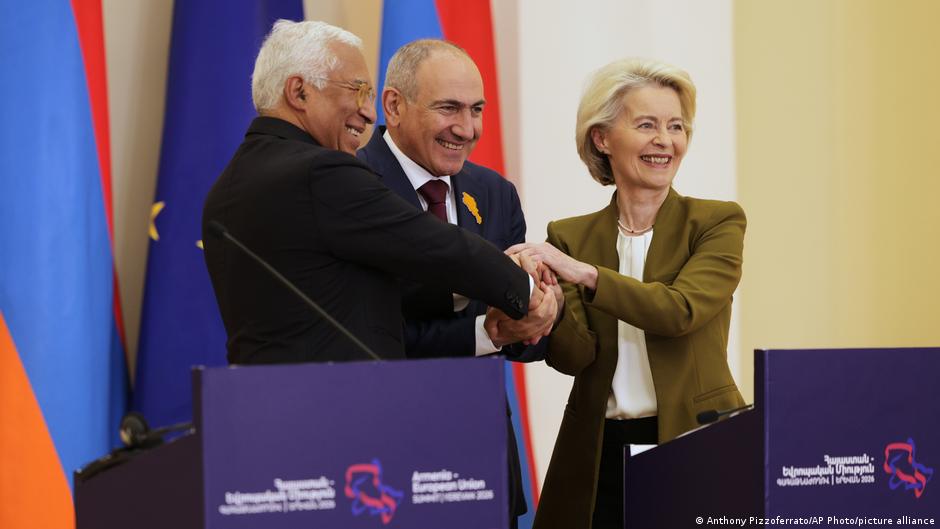
Despite Armenia's efforts to strengthen its ties with the EU, Brussels has given no clear response to the silencing of opposition voices, observers in Yerevan told DW.
(暂无翻译)
"The EU, by and large, has adopted a very pragmatic and geopolitically driven approach," said political analyst Tigran Grigoryan.
(暂无翻译)
"Given various regional developments, including what is happening in Georgia, Armenia has now become the EU's primary partner in the region," he added. "Coupled with the fact that the alternative to Pashinyan is a pro-Russian opposition, there is ultimately no serious response to these criminal cases."
(暂无翻译) (暂无翻译)
Stefan Meister, Eastern Europe expert at the German Council on Foreign Relations (DGAP), echoed this view. European support for Armenia appears to be "mainly driven by the European Russia policy," Meister said. "So it's not so much about Armenia itself, but it is more about strengthening those forces that are undermining Russia's influence in the country and in the region."
(暂无翻译) (暂无翻译) (暂无翻译)
He believes that Pashinyan leverages this geopolitical dynamic to label internal political opponents as Russian proxies. However, not everyone who criticizes Pashinyan is pro-Russian, Meister added. He pointed out that "the EU is somehow falling into this trap by accepting that this is the right narrative."
(暂无翻译) (暂无翻译) (暂无翻译)
Democracy, the rule of law, and fundamental rights are at the core of the EU-Armenia Comprehensive and Enhanced Partnership Agreement (CEPA) and the Strategic Agenda for the EU-Armenia Partnership, an EU spokesperson said in a written response to DW's request for comment.
(暂无翻译)
It also pointed out that "the EU is closely following developments in the country, including as regards criminal investigations. In line with Armenia's international commitments and legal framework, such investigations should be carried out in an independent and impartial manner, free from political considerations."
(暂无翻译) (暂无翻译)
仅供学习使用,如有侵权请联系删除 · 查看原文